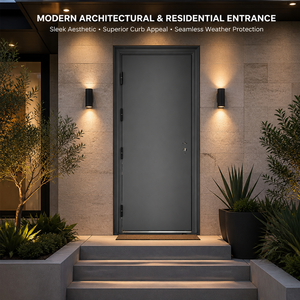
Engineered Aluminium Systems for Global Specifications
Precision-extruded building envelopes designed to comply with international acoustic, hurricane, and thermal transmission performance criteria.
25+
Years Engineering Heritage
180,000㎡
Intelligent Manufacturing Hub
600+
Specialized Technicians
100+
Global Patents & Certifications
Engineering Rigor in OEM/ODM Aluminium Door & Window Manufacturing
In modern commercial architecture and upscale residential development, the specification of architectural aluminium fabrication has transitioned from basic structural infill to complex, multi-functional building envelope engineering. As structural façades require enhanced load-bearing capabilities, high cyclic fatigue resistance, and rigorous thermal modulation, procurement directors face heightened liability. Guangdong Dejiyoupin Doors and Windows Co., Ltd. (DERCHI) operates at the convergence of heavy industrial metallurgical discipline and custom architectural fabrication, addressing these technical demands from our 180,000㎡ manufacturing complex in Foshan, Guangdong.
Metallurgical Integrity: The 6063-T5 and 6063-T6 Standard
The structural foundation of any reliable window or door system relies on billet composition and extrusion mechanics. DERCHI systems utilize primary, virgin-grade aluminium alloy 6063 homogenized to metallurgical precision. Using controlled solution heat treatment and artificial aging (T5 and T6 tempers), our structural profiles consistently achieve tensile strengths exceeding 205 MPa and yield strengths above 170 MPa.
Unlike fabricators utilizing secondary or contaminated scrap melts that cause interstitial voids and structural shearing under wind pressures, our billets maintain minimal trace element tolerances (Fe ≤ 0.35%, Mg 0.45-0.9%, Si 0.2-0.6%). This base guarantees uniform anodization response and eliminates intergranular corrosion risks, even in hypersaline marine environments such as coastal Latin America or the Caribbean.

Thermal Barrier Engineering & Polyamide Isothermal Planes
Fenestration systems remain primary conduits for conductive building heat loss and solar heat gain. Achieving target U-values lower than 1.4 W/m²·K requires deliberate separation of internal and external extrusion geometries. DERCHI employs multi-chambered, glass-fiber-reinforced (25% PA66 GF) structural insulating polyamide strips. Unlike cheaper PVC substitutes that undergo continuous thermal shrinkage and UV degradation, PA66 GF strips share an identical coefficient of linear thermal expansion with the aluminium alloy (2.3 × 10⁻⁵ K⁻¹), preventing internal shear stress, structural delamination, or profile bowing across wide operating temperatures (-30°C to 80°C).
| Performance Standard | DERCHI Test Verification | Architectural Relevance |
|---|---|---|
| Structural Wind Load Resistance | AS 2047 Serviceability (N6 Rating ≥ 4500 Pa) | Resists cyclonic wind sheer on high-rise curtain walls and villa apertures. |
| Air Permeability / Leakage | EN 12207 Class 4 (≤ 0.75 m³/h·m at 100 Pa) | Minimizes mechanical HVAC load and air leakage in passive buildings. |
| Water Penetration Resistance | ASTM E331 Static Pressure (≥ 700 Pa watertight) | Guarantees zero internal moisture entry during prolonged hurricane rains. |
| Acoustic Decibel Attenuation | ISO 10140-2 Laboratory Sound Insulation (Rw ≥ 42 dB) | Mitigates high-frequency urban traffic and low-frequency aircraft resonance. |
Total Container Consolidation
Optimize international freight margins by combining exterior entry doors, casements, interior wood assemblies, and automatic garage doors into unified, batch-inspected shipping containers directly from our factory.
Parametric Shop Drawings
Our dedicated engineering department converts client architectural schematics into detailed CAD/BIM shop drawings within 48 hours, fully clarifying wall-tie anchors, drainage slopes, and hardware placement.
Certified Coating Protection
Surface treatments utilize premium Qualicoat-certified fluorocarbon (PVDF) and architectural powder coatings, tested to withstand 3,000+ hours of continuous salt-spray exposure without blistering or chalking.
Strategic Procurement Dynamics: The 2026–2030 Fenestration Roadmap
Commercial developers and distributors are operating under shifting market expectations. Procurement strategies are heavily steered by operational carbon metrics (embodied carbon mandates) and automated intelligent manufacturing. Below are the key supply-chain shifts guiding specification over the coming cycles:
1. Shift to Low-Carbon Smelting and Closed-Loop Recycling: Municipal green building rating systems (LEED v4.1, BREEAM) now scrutinize the carbon footprint of structural assemblies. Procurement teams prioritize suppliers capable of certifying scrap recovery rates during extrusion and using hydroelectric-smelted virgin ingots to lower cradle-to-gate emissions.
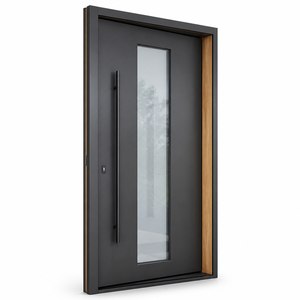
2. Transition to Large-Format, Flush-Threshold Pivoting Geometries: Conventional sliding door assemblies are giving way to floor-to-ceiling oversized pivot doors equipped with balanced concealed hydraulic closers. These configurations require heavier internal multi-chamber wall thicknesses (2.5mm to 3.0mm profiles) to prevent deflection along vertical axes exceeding 3.5 meters in height.
3. Smart Hardware Integration and Concealed Actuators: Architects increasingly demand invisible security perimeters. DERCHI manufactures systems prepared for automated building management systems (BMS), housing hidden multi-point locking mechanisms, motor actuators, and biometric access controllers integrated directly into the thermal break cavities.

Factory Verifiable Audits
Comprehensive Production Control & Global Compliance
Procuring overseas fenestration components requires transparent, verifiable manufacturing oversight. DERCHI operates with complete chain-of-custody tracking across our extrusion, corner-crimping, glazing, and packing divisions.
Every extrusion run is batch-tested for surface hardness (Webster ≥ 11), film thickness (≥ 40μm for anodization; ≥ 60μm for architectural powder coats), and corner seam shear load resistance. We invite international procurement teams, third-party inspection firms (SGS, Intertek, TÜV), or their engineering consultants to verify our Foshan facilities via remote interactive 360° VR audits or dedicated live technical streams during production runs.
Procurement & Manufacturing Answers
Technical guidance for architects, quantity surveyors, and project developers specifying custom aluminium door and window solutions.
Q: What documentation is required to generate a binding OEM fabrication quotation?
To produce an engineered bill of materials (BOM), provide architectural floor plans, elevation views, schedule sheets containing opening dimensions (W x H), wind load criteria, targeted U-values, glass compositions (e.g., 6mm Low-E + 12Ar + 6mm Tempered), and desired hardware brands.
Q: How does DERCHI ensure profile structural rigidity on oversized assemblies?
We analyze wind-load deflection based on specific installation altitudes and regional gust parameters. On high-exposure openings, we incorporate internal steel-reinforcing profile sleeves or utilize heavy-gauge multi-cavity structural profiles with wall thicknesses ranging from 2.0mm to 3.5mm.
Q: Which finishes offer the best longevity for high-UV, coastal environments?
For installations within 5 kilometers of the shoreline, we specify fluorocarbon PVDF finishes (minimum 70% Kynar 500 resin base) or marine-grade Qualicoat Class 2/3 powder coatings. These provide superior resistance to salt crystallization, Florida-standard UV degradation, and chemical chalking.
Q: What is the factory lead time from shop drawing sign-off to export container loading?
Standard architectural profiles typically require 25 to 35 production days following shop drawing sign-off. Bespoke tooling or custom extrusion die manufacturing adds approximately 12 to 18 days for die cutting, metallurgical test casting, and surface sample validation.
Q: How are fragile glass panels and wide frames secured for ocean voyages?
Every fenestration unit undergoes protective film masking, protective corner bumpers, high-density polyethylene sheet wrapping, and fully enclosed, heat-treated fumigated plywood crates. Crates are fixed with internal steel strapping to prevent movement inside the container during maritime transit.
Q: Can DERCHI match project hardware to specific third-party access systems?
Yes. Our CNC profile milling centers work directly from digital CAD coordinate maps. We easily route hardware cavities for European standard groove fittings (C-groove, Euro-groove), North American multi-point panic latches, concealed door closers, or motorized access hardware.