Engineered Architectural Windows & Entry Systems
Explore our precision-fabricated aluminum fenestration lineups. Built strictly to international testing benchmarks (CE, AS2047, NFRC, ASTM), our products deliver unmatched structural load ratings, acoustic dampening, and advanced thermal boundary isolation.
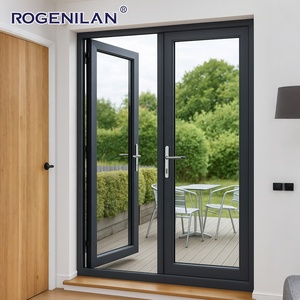
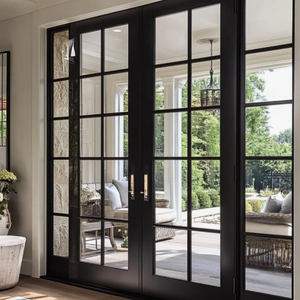
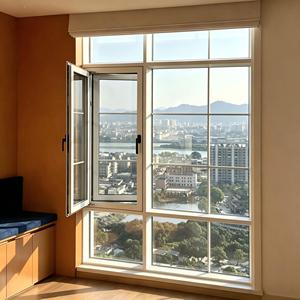
The Mechanics of High-Performance Aluminum Hopper Windows
Aluminum hopper windows represent a cornerstone of passive ventilation, envelope hermeticity, and mechanical safety. Unlike casement units swinging outwards or hung windows relying on counterbalances, the hopper window hinges along the bottom rail, tilting inward from the top.
Polyamide Thermal Isolation (PA66 GF25)
Structural aluminum features high thermal conductivity (approx. 160 W/m·K). As an export-oriented manufacturer, our systems incorporate multi-chambered 24mm to 34mm PA66 reinforced with 25% fiberglass thermal barrier strips, isolating the exterior alloy extrusion from interior ambient conditions and achieving system U-values down to 1.1 W/m²·K.
- Eliminates interior surface condensation & frost bridging
- Co-extruded EPDM center compression gaskets
- Optimized for extreme sub-zero or high-humidity zones
Perimeter Multi-Point Cam Locking
Hopper windows excel in sealing performance due to continuous mechanical compression. Actuating the ergonomic central handle drives stainless steel espagnolette rods connected to mushroom-head cams into hardened zinc strike plates around the sash perimeter, delivering uniform gasket clamp pressure.
- Surpasses ASTM E283 air infiltration standards (<0.1 cfm/ft²)
- EN 12207 Class 4 airtight hermetic containment
- Enhanced forced-entry resistance for basement & ground-level sills
Acoustic Decoupling & Triple Glazing
Hopper configurations frequently serve in urban transit zones, basements, and institutional clerestories. Our profiles accommodate insulated glass units (IGUs) up to 48mm thick, allowing asymmetrical laminated panes (e.g., 6mm Low-E + 16Ar warm edge + 4mm + 12Ar + 6.76mm acoustic PVB) to suppress low-frequency structural noise.
- Sound Transmission Class (STC) ratings up to 43 dB
- Argon gas fill with 90%+ concentration durability
- Warm-edge composite spacers reducing edge heat loss
| Performance Specification | Standard Non-Thermal Aluminum | Architectural Thermal Break Hopper | Commercial Heavy-Duty Passive Spec |
|---|---|---|---|
| Thermal Transmittance (U-Value) | 5.8 – 6.2 W/m²·K (High Loss) | 1.5 – 1.8 W/m²·K Standard | 0.85 – 1.2 W/m²·K Passive Certified |
| Air Permeability (EN 12207 / ASTM E283) | Class 2 (≤ 27 m³/h·m²) | Class 4 (≤ 3 m³/h·m² @ 600Pa) | Class 4 (≤ 0.05 cfm/ft² @ 300Pa) |
| Water Penetration Resistance (EN 12208) | Class 3A (150 Pa) | Class 9A (600 Pa) | Class E1050 (≥ 1050 Pa Hurricane) |
| Wind Load Structural Rating (EN 12210) | Class B2 (800 Pa) | Class C4 (1600 Pa) | Class C5 (2000+ Pa Heavy Windload) |
| Acoustic Isolation (Rw / STC) | 26 – 29 dB | 35 – 38 dB | 40 – 44 dB (Acoustic Interlayer) |
| Hardware Cycle Life (EN 13126-8) | 10,000 Cycles | 25,000 Cycles | 50,000+ Heavy Duty Cycles |
Future Procurement & Technology Trends (2025–2030)
International facade engineers and project contractors are shifting procurement strategies toward modular, intelligent, and low-embodied-carbon fenestration assemblies. Learn how top Chinese manufacturers lead these global paradigm shifts.
Smart Actuation & Building Automation (BMS)
Hopper windows installed in clerestory positions, atriums, or hospital sanitization zones are increasingly integrated with concealed 24V DC electric chain actuators. Modern procurement orders demand dry-contact or KNX/BACnet bus protocol compatibility, automating night-purge cooling and smoke exhaust ventilation during fire emergencies without breaking visual sightlines.
Decarbonization & Circular Billets (Low-Carbon Al)
European (EPBD) and North American sustainability frameworks mandate strict Environmental Product Declarations (EPD). Chinese top tier exporters now utilize hydroelectricity-smelted primary aluminum billets paired with closed-loop industrial scrap recycling, reducing embodied carbon to under 4.0 kg CO&sub2;e per kg of extruded aluminum profile without compromising tensile yield strength.
Factory-Integrated Subframes & Unitization
On-site construction labor costs across Australia, Europe, and the Americas have surged. Forward-looking developers specify pre-assembled, factory-flashed subframe extrusions with integrated dry-glazing EPDM pockets. This reduces installation times from hours to minutes, prevents job-site silicone sealant failure, and guarantees envelope air barrier continuity.
Why Global Importers Partner with Our Foshan Manufacturing Hub
Headquartered in Foshan, China's world-renowned aluminum and fenestration capital, Guangdong Dejiyoupin Doors and Windows Co., Ltd. (DERCHI) stands among China's Top 10 fenestration enterprises. We offer turnkey, single-source manufacturing capacity for architects, B2B distributors, and commercial general contractors.
180,000㎡ Mega-Scale Production Base
Our automated extrusion, powder-coating, thermal break assembly, and precision CNC cutting facilities span over 180,000 square meters, ensuring dependable mass production and scalable delivery schedules for multi-story towers.
Global Testing Compliance
We design and test products to international requirements: Australian AS2047, European CE, ISO9001, North American NFRC/AAMA, and UL fire ratings. Complete lab test documentation is available for local building code verification.
Free CAD/BIM Shop Drawings
Our in-house facade engineering department reviews architectural openings and provides complete shop drawings, structural wind load deflection calculations, and anchoring details prior to extrusion cutting.
Ocean Export Heavy Crating
Every hopper window unit undergoes full pre-assembly, protective film wrapping, corner shock absorption, and custom fumigation-free OSB/plywood crate crating for zero-damage container transits worldwide.
Frequently Asked Questions by Commercial Buyers
Get direct answers on profile alloys, hardware selection, minimum order quantities (MOQs), international shipping logistics, and architectural customization.
What are the distinct structural differences between an Aluminum Hopper Window and an Awning Window?
What aluminum alloy profile thickness and thermal barrier do you employ for export orders?
How do aluminum hopper windows ensure waterproof tightness and avoid rainwater ingress?
What hardware options are offered (manual restrictor arms, friction stays, motorized actuators)?
Can we consolidate hopper windows with entry doors and sliding systems in a single container?
What surface finishes and anti-corrosion treatments are available for coastal projects?
What is your typical production lead time, and how do you guarantee dimensional accuracy?
Streamline Your Fenestration Sourcing from China
Connect directly with our senior fenestration facade engineers. From initial architectural concept sketches and thermal simulations to container loading and job-site installation guidance, DERCHI delivers precision engineering at competitive factory-direct pricing.