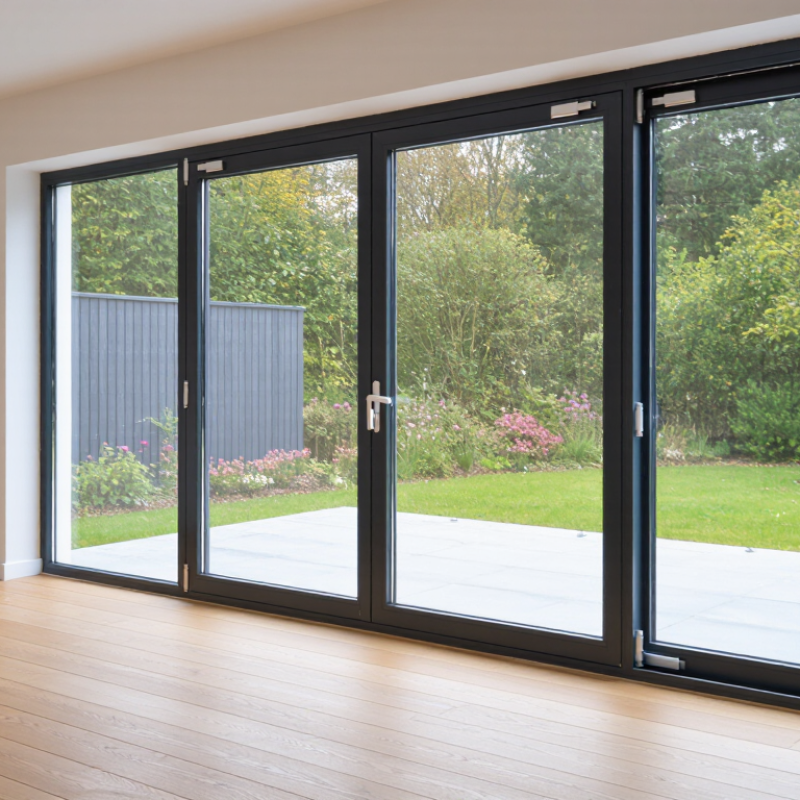
| Standard Sliding Door |
Panels slide horizontally along parallel tracks, with one or more panels moving behind fixed panels. |
Usually two, three, or four panels depending on the opening width. |
Practical operation, space-saving design, wide glass areas, and generally straightforward installation. |
Most panels do not open completely across the full width; the track requires regular cleaning and adjustment. |
Varies by frame design, glass specification, seals, and installation quality. Thermally broken frames provide better insulation than non-thermally broken frames. |
Patios, balconies, living rooms, bedrooms, and medium-to-large exterior openings. |
| Lift-and-Slide Door |
The handle raises the panel slightly off its seals before the panel is moved along the track. |
Commonly supplied as two, three, or four large panels. |
Supports larger and heavier panels, offers smooth movement, and can provide strong weather sealing when closed. |
Usually costs more and requires accurately installed, well-supported tracks and high-quality hardware. |
Typically strong when paired with thermally broken aluminium frames, insulated glass, continuous seals, and a properly drained sill. |
Large glazed openings, premium residential projects, and areas requiring substantial daylight and improved weather resistance. |
| Multi-Panel Sliding Door |
Several panels slide along multiple tracks to create a wider opening than a basic two-panel system. |
Often includes three, four, or more panels with fixed and moving sections. |
Creates broad views, increases natural light, and can cover wide architectural openings. |
More tracks and components may increase cleaning, maintenance, and installation complexity. |
Depends heavily on the number of joints, frame depth, glazing type, and quality of the weather seals. |
Open-plan rooms, wide patios, garden-facing elevations, and modern architectural designs. |
| Pocket Sliding Door |
One or more panels slide into a concealed pocket within an adjacent wall when opened. |
Single or multiple panels, depending on the wall construction and opening design. |
Can provide an almost fully clear opening and gives a clean, minimal appearance when the door is open. |
Requires suitable wall space, careful waterproofing, and access for future hardware or seal maintenance. |
Can perform well, but the concealed pocket and surrounding wall details must be designed to control air, water, and thermal bridging. |
New-build projects, indoor-outdoor living areas, and designs prioritising maximum clear access. |
| Corner Sliding Door |
Two sliding door runs meet at a corner, often with a minimal or post-supported corner junction. |
Typically uses two sets of panels arranged at a right angle. |
Maximises corner views, improves daylight, and can create a strong connection between interior and exterior spaces. |
Corner detailing is more demanding; structural support, drainage, alignment, and weather sealing require specialist design. |
Performance depends on the corner junction, frame design, glazing, drainage, and installation accuracy. |
Contemporary homes, corner rooms, terraces, and projects with panoramic view requirements. |
| Thermally Broken Sliding Door |
An insulating polyamide or similar thermal barrier separates the inner and outer aluminium sections of the frame. |
Available in standard, lift-and-slide, multi-panel, and other sliding configurations. |
Reduces heat transfer through the frame, improves interior comfort, and helps reduce condensation risk compared with basic non-thermally broken systems. |
Usually has a higher purchase price and may require deeper profiles or more specialised installation. |
Generally the preferred aluminium option for improved energy efficiency, although the complete door performance also depends on the glass, seals, threshold, and installation. |
Energy-conscious homes, cooler or hotter climates, conditioned interiors, and high-performance building projects. |
| Non-Thermally Broken Sliding Door |
The aluminium frame has no continuous insulating barrier between its inner and outer sections. |
Commonly used in simple sliding door systems and lightly conditioned spaces. |
Usually lighter, simpler, and more economical than thermally broken alternatives. |
Allows more heat transfer through the frame and may have a higher condensation risk in cold or humid conditions. |
Lower frame insulation performance than a thermally broken system; suitability depends on climate, use, and local building requirements. |
Mild climates, internal partitions, garages, utility areas, and projects where budget is the primary consideration. |